
More than 4.400 child sexual abuse materials removed from the online environment in the first six months of the year. International Center “La Strada” highlights the responsibility of digital platforms.
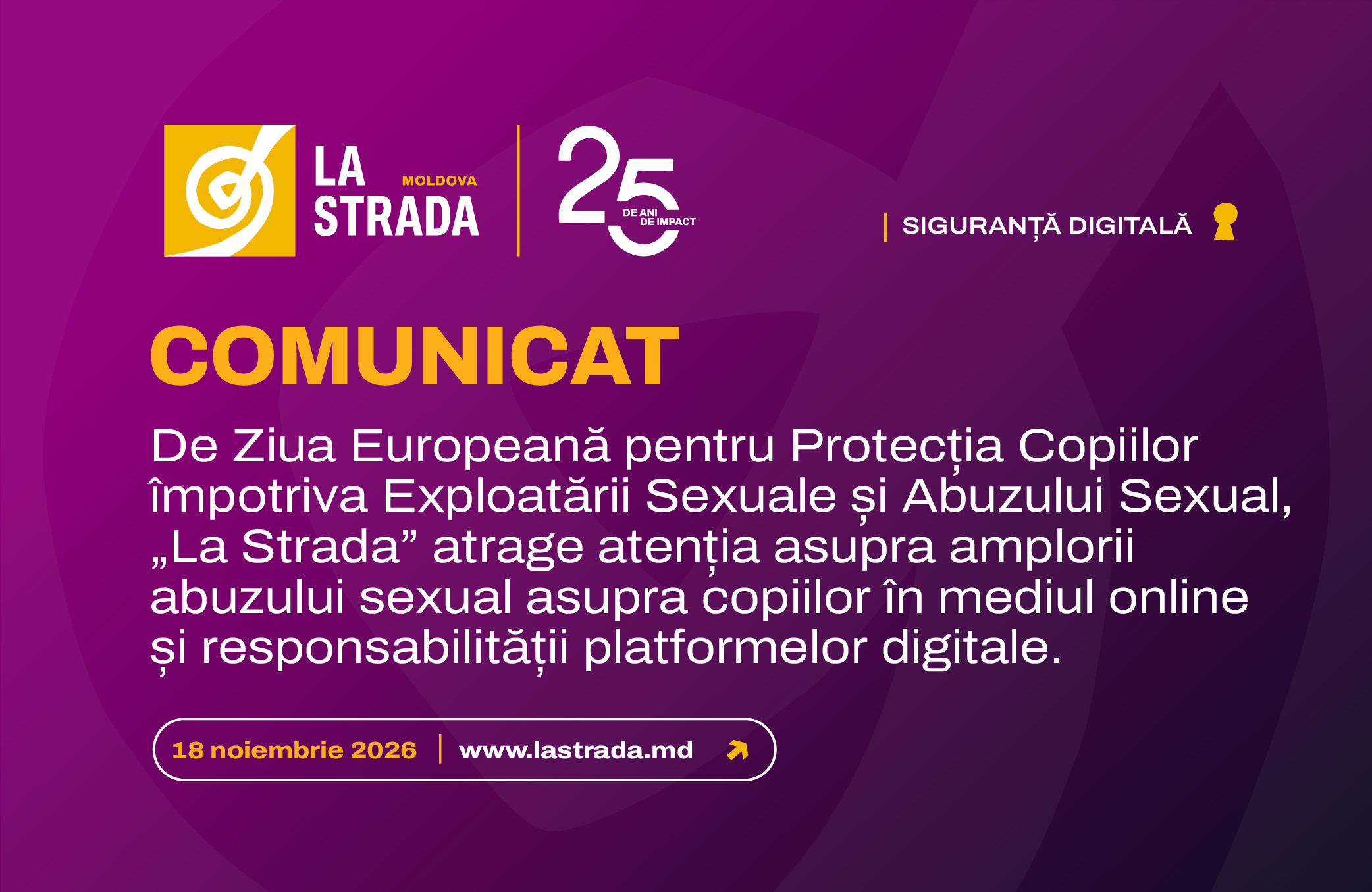
On the occasion of the European Day on the Protection of Children against Sexual Exploitation and Sexual Abuse (18 November), International Center “La Strada” draws attention to the scale of child sexual abuse in the online environment and to several challenges that call for stronger cooperation between authorities, specialised services and digital platforms.
The organisation’s data and findings were presented during a meeting of the specialised Commission of the National Human Rights Council, coordinated by the Ministry of Internal Affairs and responsible for monitoring the implementation of the Council of Europe Convention on the Protection of Children against Sexual Exploitation and Sexual Abuse (the Lanzarote Convention). The meeting took place on 12 November 2026 and was organised by the Ministry of Internal Affairs with the support of the Council of Europe.
During the first six months of 2026, the National Reporting Service for Child Sexual Abuse Material – SigurOnline Hotline, operated by International Center “La Strada” in partnership with the General Police Inspectorate, registered 4,547 reports, of which 4,431 were found to contain illegal material. Following the interventions, 4,414 illegal materials were removed from the online environment.
More than half of the removed materials, namely 2,512, depicted children aged between 3 and 13, while another two materials involved children under the age of three. Furthermore, 634 reports involving illegal content were resolved through the removal of the materials on the very day they were reported.
These results highlight the importance of specialised reporting mechanisms and national and international cooperation in identifying and removing child sexual abuse material. At the same time, the experience of the services provided by the Safer Internet Centre from Moldova points to three challenges requiring increased attention.
- The commercialisation of child sexual abuse material. The distribution and commercialisation of such material in the digital environment constitute a serious form of sexual exploitation, in which the abuse of children is used to obtain financial benefits. Addressing this phenomenon requires not only identifying and removing the material, but also investigating the mechanisms through which it is distributed and commercialised, identifying the individuals involved and strengthening international cooperation.
- Insufficient intervention by digital platforms in reported cases of abuse. Specialists from the SigurOnline Helpline report situations in which intimate images shared without consent or accounts used to harass children remain accessible despite repeated reports. Among the platforms mentioned by beneficiaries are TikTok and Telegram. In one documented case, a child reported having submitted more than 30 reports concerning the distribution of their intimate images, without the respective accounts being removed or the harassment coming to an end.
- The proliferation of fake accounts and the perpetuation of online abuse. The unauthorised use of children's photographs and personal data to create fake accounts facilitates intimidation, humiliation and the non-consensual distribution of intimate images. The creation of new accounts can enable abuse to continue even after the original accounts have been blocked or removed. In some cases, the consequences extend beyond the digital environment, with children also being subjected to intimidation and humiliation at school.
The experience of SigurOnline services raises an essential question: who takes responsibility for protecting a child when they repeatedly report abuse, yet the content remains accessible and the harassment continues?
Although children are encouraged to report abuse and seek help, the responsibility for stopping such behaviour cannot be transferred to the victims. Nor can the intervention of specialised services replace the measures that digital platforms must take to prevent and combat abuse occurring through their services.
At European level, the Digital Services Act (DSA) and, more recently, the proposed EU Kids Act reflect an approach that places increasing emphasis on the responsibility of digital service providers to protect children, including by integrating safety measures into the design and operation of their platforms.
As a candidate country for European Union membership, the Republic of Moldova needs to identify and develop legal, institutional and international cooperation mechanisms to hold digital platforms accountable for the protection of children. These should ensure effective reporting and response mechanisms, the prompt removal of abusive content and the prevention of repeated victimisation, including through the use of multiple accounts. Alignment with European standards should not be merely an exercise in legislative harmonisation, but also an opportunity to develop concrete mechanisms through which digital platforms can respond effectively to situations of abuse affecting children in the Republic of Moldova.
The protection of children in the digital environment is a shared responsibility, but this must not lead to the dilution of each actor's individual accountability. Digital platforms must assume an active role in preventing and stopping abuse occurring through the services they provide.
During the meeting of the Lanzarote Committee, International Center “La Strada” reiterated the need to draw on the experience of specialised services when developing national measures to prevent and combat the sexual abuse and exploitation of children.
The development of the Safer Internet Centre from Moldova, co-funded by the European Union through the Digital Europe Programme, provides a framework for strengthening cooperation between public institutions, specialised services and the private sector, as well as for bringing national mechanisms closer to European standards on child online safety.
The experience gained through the SigurOnline Hotline and Helpline services can help identify gaps in existing mechanisms and inform the development of concrete measures, including as part of the preparation of the new Set of Measures for the implementation of the Lanzarote Convention for 2027–2028. International Center “La Strada” reaffirms its readiness to support the authorities in this process and to promote a response in which every stakeholder assumes clear responsibilities for preventing abuse, ensuring effective intervention and protecting child victims.
Suspected child sexual abuse material can be reported anonymously and safely through the SigurOnline Hotline by visiting www.siguronline.md. Through the same platform, children, parents and professionals can also access information and counselling in situations involving online abuse.